
As I predicted, Netflix and movie-watching have taken over my life. I present you proof of my existence:
The Squid and the Whale (Baumbach, 2005)
So painful it’s funny; so funny it’s painful. The Squid and the Whale is the best movie I’ve seen all year. Writer-director Noah Baumbach’s semi-autobiographical take on his parent’s divorce is brimming with pointed barbs, bravely mocking the very intellectual audience that the film appeals to. The opening sequence of the family tennis match perfectly establishes the family dynamic in a matter of minutes—older son Walt and pompous dad Bernard vs. younger son Owen and mother Joan. This intimate, character-driven dramedy cuts a clear slice of life with its keen insight and sharp wit. It’s one of those movies that make loving movies worthwhile. A
P.S. I don’t understand why people keep comparing The Squid and the Whale with The Royal Tenenbaums. As much as I adore Wes Anderson, he can have all of his funky costumes, anamorphic lens, and big budgets, but he has yet to touch the poignancy of Squid’s biting realism.
28 Days Later (Boyle, 2003)
Honestly, I’m not usually one for zombie movies—schlock horror has never appealed to me beyond “Let’s get scared for Halloween.” But 28 Days Later, directed by the genre-hopping Danny Boyle and written by Alex Garland, is a genuine fright that electrified me for two hours. The gritty DV gives the film an eerie realism, especially during the shots of an empty London. Cillian Murphy’s blue eyes reflect the startling terror that permeates this multi-layered film. B+
Secretary (Shainberg, 2002)
Love with a kinky twist—that’s the premise of the dark S&M comedy Secretary. Maggie Gyllenhaal gamely turns into the shy Lee Holloway, who returns from a stint at the mental institution to work for James Spader’s domineering lawyer Mr. Grey. Secretary is an office romance that works out better than it should, picking up the dark and the funny but never passing judgment. It’s a bit too bare bones, but the inspired art design and costumes give it a wholly original weight. B
The Sea Inside (Amenábar, 2004)
Melodrama is at tricky genre, and director Alejandro Amenábar fails to temper the melodrama of The Sea Inside into a good movie. About quadriplegic Ramón Sampedro’s struggle to die with dignity, the film hardly focuses on the psychology of the man himself, instead settling to manufacture drama out of Ramón’s surrounding friends and family. Some stunning cinematography hardly makes up for the inert and lifeless direction. D+
Friday, June 30, 2006


Thursday, June 29, 2006
I Heart Huckabees (Russell, 2004)
Tell me the significance of this coincidence: I’ve watched 3 random movies recently—Shopgirl, Rushmore, and now I Heart Huckabees—all featuring actor Jason Schwartzman. And in all three movies, Schwartzman has played a lovable schmuck with bad hair and less-than-desirable professions.
The lovable schmuck played by Schwartman in I Heart Huckabees, Albert Markovski, also stumbles on a puzzling coincidence. After meeting a tall African man at three chance encounters, Albert decides to take his case to Jaffe & Jaffe (Lily Tomlin and Dustin Hoffman), a husband and wife team of existential detectives.
Existential what? Yes, detectives. This is where we know that David O. Russell’s soup and nuts existential comedy I Heart Huckabees is as just as well soupy and nutty. As the existential detectives pry into Albert to find the meaning of his life, we see his quixotic quest to save a swamp from the evil denizens of Huckabee’s, a Wal-Mart like corporate bulldozer. Along the way, the script also throws in a depressed firefighter lecturing on the evils of petroleum (Mark Wahlberg), a French philosopher/sexpot (Fanny Ardant) Huckabee’s golden boy and Albert’s nemesis Brad Stand (Jude Law), and his ditzy girlfriend Dawn (Naomi Watts), who also happens to Huckabee’s spokeswoman.
The characters’ tangential importance in Albert’s life is well…tangential, but they’re here because, as Jaffe and Jaffe claims, “Everything is connected.” Too bad this disparate movie itself can’t figure out exactly how they’re connected. Add in monkey sex in the mud, whacking faces with balls, an Amish bonnet, (deliberately) cheesy special effects, and here we have a movie drowning in the kitchen sink.
Only Jude Law and Naomi Watts manage to stay half afloat in this messy puddle. As Jaffe and Jaffe continue their poking, Brad’s life begins spiraling downward, much to Albert’s schadenfraudelicious delight. Even with a shoddy American accent and a bad dye job, not to mention fake breasts and a long blonde wig in one scene, Law exudes enough charisma to almost give this movie a reason to exist. Watts provides the only other perk in this otherwise dull comedy as the hopelessly ditzy Dawn, who turns on the frump after an encounter with Jaffe and Jaffe. “You can’t deal with the infinite nature of my existence,” shouts Dawn in an Amish bonnet and overalls. “Yes, I can…Wait, what do you mean” answers Brad. The titter tat between this seemingly golden couple is the only comedy find you’re going to mine at Huckabees.
There are some other cheap laughs at the sheer ridiculousness of the situations, but none of the wit you would expect from such a highbrow concept. Or maybe those lightning fast one-liners were witty, but they are thrown out with such blasé that they hardly lingered in the air. Huckabees is light on characters and heavy on philosophy, or at least the name-dropping of it. But for a movie about philosophy, it sure doesn’t provoke much thought.
I
n keeping with its peek-a-boo narrative, Huckabees doesn’t tell us the meaning of life; it doesn’t even tell us the meaning of Albert’s coincidence. As for my coincidence of watching Jason Schwartman films, let’s just say there is no significance, just as I Heart Huckabees has none either. But perhaps Russell wanted to make an inane and absurd comedy about the inanity and absurdity of philosophical musings. In that case: Bravo, you’ve made a good point. Now make a good movie.
The lovable schmuck played by Schwartman in I Heart Huckabees, Albert Markovski, also stumbles on a puzzling coincidence. After meeting a tall African man at three chance encounters, Albert decides to take his case to Jaffe & Jaffe (Lily Tomlin and Dustin Hoffman), a husband and wife team of existential detectives.
Existential what? Yes, detectives. This is where we know that David O. Russell’s soup and nuts existential comedy I Heart Huckabees is as just as well soupy and nutty. As the existential detectives pry into Albert to find the meaning of his life, we see his quixotic quest to save a swamp from the evil denizens of Huckabee’s, a Wal-Mart like corporate bulldozer. Along the way, the script also throws in a depressed firefighter lecturing on the evils of petroleum (Mark Wahlberg), a French philosopher/sexpot (Fanny Ardant) Huckabee’s golden boy and Albert’s nemesis Brad Stand (Jude Law), and his ditzy girlfriend Dawn (Naomi Watts), who also happens to Huckabee’s spokeswoman.
The characters’ tangential importance in Albert’s life is well…tangential, but they’re here because, as Jaffe and Jaffe claims, “Everything is connected.” Too bad this disparate movie itself can’t figure out exactly how they’re connected. Add in monkey sex in the mud, whacking faces with balls, an Amish bonnet, (deliberately) cheesy special effects, and here we have a movie drowning in the kitchen sink.
Only Jude Law and Naomi Watts manage to stay half afloat in this messy puddle. As Jaffe and Jaffe continue their poking, Brad’s life begins spiraling downward, much to Albert’s schadenfraudelicious delight. Even with a shoddy American accent and a bad dye job, not to mention fake breasts and a long blonde wig in one scene, Law exudes enough charisma to almost give this movie a reason to exist. Watts provides the only other perk in this otherwise dull comedy as the hopelessly ditzy Dawn, who turns on the frump after an encounter with Jaffe and Jaffe. “You can’t deal with the infinite nature of my existence,” shouts Dawn in an Amish bonnet and overalls. “Yes, I can…Wait, what do you mean” answers Brad. The titter tat between this seemingly golden couple is the only comedy find you’re going to mine at Huckabees.
There are some other cheap laughs at the sheer ridiculousness of the situations, but none of the wit you would expect from such a highbrow concept. Or maybe those lightning fast one-liners were witty, but they are thrown out with such blasé that they hardly lingered in the air. Huckabees is light on characters and heavy on philosophy, or at least the name-dropping of it. But for a movie about philosophy, it sure doesn’t provoke much thought.
I
n keeping with its peek-a-boo narrative, Huckabees doesn’t tell us the meaning of life; it doesn’t even tell us the meaning of Albert’s coincidence. As for my coincidence of watching Jason Schwartman films, let’s just say there is no significance, just as I Heart Huckabees has none either. But perhaps Russell wanted to make an inane and absurd comedy about the inanity and absurdity of philosophical musings. In that case: Bravo, you’ve made a good point. Now make a good movie.
Summer Bitchin'
Hah, life has depressed into another one of those summer lulls. My body has been taken hostage by a full bout of inert forces, turning me into a lumpy potato. Ambulatory matters become ones of exertion. Funny how I used to feel that summer days dragged on and on because now I look back each night and think, "Where did my day go?" The clock ticks and the pendulum swings as I sit aimlessly browsing the Internet.
Having received my report card, I can finally cleanse my hands of junior year--a year mostly unremarkable now that I think about it. It didn't kill me, nor tickle me, nor amuse me. It was just there. To my utmost surprise, I managed to scrape an A- in English, a feat I had previously deemed impossible. My dad looked at my report card and gave a look of relief, "You haven't gotten any B's ever, right?" Whatever, I get the distinct feeling that my dad knows my grades much better than I do.
A pile of library DVDs, 5 boxes high, sits next to my bed away from the prying eyes of my parents. Sigh, how will I ever get through them and still be content with reality? Netflix is being really shitty about logging my returned DVDs; I beginning to experience that wonderful thing called "throttling." I need to give them a bitch call once I find their phantom customer service number.
AP Psych class slides deeper and deeper into oblivion and uselessness. For my next assignment, I'm supposed to give on example of why I am in to the Genital Stage of Freud's psychosexual development. Why is CTY telling us, a assembled group of geeks and nerds, to spill our sex lives?
Having received my report card, I can finally cleanse my hands of junior year--a year mostly unremarkable now that I think about it. It didn't kill me, nor tickle me, nor amuse me. It was just there. To my utmost surprise, I managed to scrape an A- in English, a feat I had previously deemed impossible. My dad looked at my report card and gave a look of relief, "You haven't gotten any B's ever, right?" Whatever, I get the distinct feeling that my dad knows my grades much better than I do.
A pile of library DVDs, 5 boxes high, sits next to my bed away from the prying eyes of my parents. Sigh, how will I ever get through them and still be content with reality? Netflix is being really shitty about logging my returned DVDs; I beginning to experience that wonderful thing called "throttling." I need to give them a bitch call once I find their phantom customer service number.
AP Psych class slides deeper and deeper into oblivion and uselessness. For my next assignment, I'm supposed to give on example of why I am in to the Genital Stage of Freud's psychosexual development. Why is CTY telling us, a assembled group of geeks and nerds, to spill our sex lives?
Tuesday, June 27, 2006
Why I Will Never Be a Doctor: Day 2
On the hierarchy at Emerson, I am at the very bottom. The amoeba of the food chain. The last rung. The farthest from the hub. One of those newbie volunteers who stumble through the hospital with a hesitant step and unsure gaze. So today was a sophomore volunteer effort at Emerson Hospital—a mostly mind-numbing unexercise spent in the butt-numbing seat at reception.
As far as volunteer experiences go, today was actually was quite pleasant because everyone was so damn nice. The problem: I didn't meet many people, as I spent 4 hours in a lobby with a traffic of 25 human bodies per hour—the vast majority of which whirled by without a gaze. One woman even deigned to say to me, “You must be soooo bored!”
Word.
Although 95% of my time was spent trying not to look bored, a few interesting moments did pop up. Not especially interesting, mind you, because in the context of these events, even an ant crawling would have been a welcome relief.
Exhibit A:
Man walks in.
Man: Is plastic surgery on the 7th floor?
Me: Let me check.
Me (thinking): What? Emerson does plastic surgery? This guy is pretty good looking in a creepy hot villain kind of way; he shouldn’t be having plastic surgery.
Man pulls out hand with 2-inch festering sore.
Me (thinking): Ooooooh. It looks like an acid burn.
Exhibit B:
Woman: “Excuse me sir, can you tell me what time it is?”
Man 1: “Oh sorry. I didn’t look when I left.”
Woman: “Am I making you nervous? Am I?”
Man 1: “Hey, there’s a clock right there” Points to wall.
** 1 minute later **
Woman: “Excuse me sir, do you know what time it is?”
Man 2: “It’s 4:21.”
The lady must have asked for the time on at least 4 different instances within a span of 10 minutes. Huh.
Exhibit C:
Woman (same one): “Hey look! I think that lady is Innn-dian. Doesn’t she look like she’s from Innn-dia? You know, there are so many Innn-dian people in Woburn. Doesn’t she look like she’s from Innn-dia?”
Alright, I’m done. I’m probably violating a great many patient confidentiality rules and deserve to be fired. Boredom must be the seed of all maliciousness.
As far as volunteer experiences go, today was actually was quite pleasant because everyone was so damn nice. The problem: I didn't meet many people, as I spent 4 hours in a lobby with a traffic of 25 human bodies per hour—the vast majority of which whirled by without a gaze. One woman even deigned to say to me, “You must be soooo bored!”
Word.
Although 95% of my time was spent trying not to look bored, a few interesting moments did pop up. Not especially interesting, mind you, because in the context of these events, even an ant crawling would have been a welcome relief.
Exhibit A:
Man walks in.
Man: Is plastic surgery on the 7th floor?
Me: Let me check.
Me (thinking): What? Emerson does plastic surgery? This guy is pretty good looking in a creepy hot villain kind of way; he shouldn’t be having plastic surgery.
Man pulls out hand with 2-inch festering sore.
Me (thinking): Ooooooh. It looks like an acid burn.
Exhibit B:
Woman: “Excuse me sir, can you tell me what time it is?”
Man 1: “Oh sorry. I didn’t look when I left.”
Woman: “Am I making you nervous? Am I?”
Man 1: “Hey, there’s a clock right there” Points to wall.
** 1 minute later **
Woman: “Excuse me sir, do you know what time it is?”
Man 2: “It’s 4:21.”
The lady must have asked for the time on at least 4 different instances within a span of 10 minutes. Huh.
Exhibit C:
Woman (same one): “Hey look! I think that lady is Innn-dian. Doesn’t she look like she’s from Innn-dia? You know, there are so many Innn-dian people in Woburn. Doesn’t she look like she’s from Innn-dia?”
Alright, I’m done. I’m probably violating a great many patient confidentiality rules and deserve to be fired. Boredom must be the seed of all maliciousness.
Saturday, June 24, 2006
Y tu mamá también (Cuarón, 2001)

Conventional wisdom tells us that to make a serious movie, you must have serious characters. Y tu mamá también flippantly dismisses this rule in the same way its two obnoxious, immature protagonists flippantly dismiss everything else.
These protagonists are Julio (Gael García Bernal) and Tenoch (Diego Luna), two Mexican teenagers bent on getting high and getting laid. When their girlfriends depart to Italy for the summer, the two best friends are bored out of their minds, resorting to whacking off in the swimming pool.
At a family wedding, the boys meet Luisa (Maribel Verdú), a beautiful, older Spanish woman married to Tenoch’s arrogant prick of cousin. (Such a characterization would aptly describe Julio and Tenoch as well.) On a lark, they flirt with Luisa by asking her to a fictional beach called Heaven’s Mouth. When she unexpectedly accepts, the threesome departs on an improvised road trip, rife with juvenile jokes and rowdy sex.
If Y tu mamá también is sounding like American Pie: Mexican Road Trip Edition, it isn’t. Yes, it begins with the teenagers having sex with their girlfriends. Yes, there are two fart jokes in the first ten minutes. Yes, there are enough sex, drugs, and swears for a very naughty teen movie. But Y tu mamá también is, after all, a “serious” film. A serious film that treats its immature characters with not disdain but care, and chronicles life’s gritty realities through a distant but perceptive lens.
Although there are three physical characters on the road trip—Luisa, Julio, and Tenoch—there is a fourth character built from the roving camera and omniscient narration. The script, written by director Alfonso Cuarón and his brother Carlos Cuarón, is much keener than its characters. As Julio casually complains about the bad traffic, the camera meanders aside to find a covered corpse, and the narrator tells us the man was killed because he had no choice but to cross the busy street to get to work. Throughout the film, the camera wanders off the road into one of those poignant tangents, abandoning our characters for a brief moment to remind us of the world outside their insular lives. Director Cuarón does a deft job with juggling relationship of his three main characters and the film’s greater ambitions. The almost blasé manner of social and political commentary—the narration simply tells, it never judges—gives Y tu mamá también a weight that never seems laden with pretension. After all, Julio and Tenoch themselves could care less about the dead man.
Luisa, played magnificently by Verdú, is the anchor of the film as the older, wiser woman. She has her own mysterious reasons for going on the road trip, reasons that Julio and Tenoch would not understand even if they knew. It is Luisa with whom the audience sympathizes while laughing at the clumsiness of the boys in their attempts to woo her. Even with their shameless immaturity, Julio and Tenoch become almost endearing in their own pathetic manner. Although such a road trip should bring two best friends closer, the teenagers drift and jolt apart. When they finally reach Heaven’s Mouth, they are no longer friends, and by the end of the movie, they are certainly no longer boys.
Y tu mamá también is indeed a road trip movie with lots of sex and nudity, but it is so much more. What makes it memorable is not the immediate punch of brazen sexuality or pulsing energy, but its lingering and haunting sadness.
Filmic Update: Spaceballs, Psycho, Rushmore, and Your Mother Too
Spaceballs (Brooks, 1987)
Even for someone who last watched Star Wars at the age of 8, Spaceballs’ parody of George Lucas was dead on and an utter hoot. If only Star Wars itself were that entertaining.
Psycho (Hitchcock, 2001)
Entirely deserving of its classic status. The first half is slow and Marion Crane is boring, but Psycho picks up in the second, peaking in one of the most shocking and memorable finales of film history—and I say this having only watched a tiny fraction of movies ever made. The perfect, unsuspecting villain: actor Anthony Perkins is insanely brilliant.
Rushmore (Anderson, 1998)
<3 Max Fischer. <3 Bill Murray. <3 Wes Anderson. <3Rushmore.
Y tu mamá también (Cuaron, 2001)
If this film is an accurate description of teenage male behavior, I think I’ve lost all hope in humanity. Julio and Tenoch are the most immature pricks I have ever encountered in reel or real life. It is usually a bad sign when the DVD special features are more interesting than the actual movie, but then, the making-of featurette was a just awesome. Although my initial reaction was very bleh, the film won’t let me forget it. On the sex: maybe my threshold for tolerance has gone way up, but I didn’t find it that shocking or even sexy for that matter--except for one scene.
Yay for HoYay! Gael + Diego = One Hot Kiss.
Internet, you fail me. How can there be no screencaps of this? Oh I see, google safesearch was on.
Even for someone who last watched Star Wars at the age of 8, Spaceballs’ parody of George Lucas was dead on and an utter hoot. If only Star Wars itself were that entertaining.
Psycho (Hitchcock, 2001)
Entirely deserving of its classic status. The first half is slow and Marion Crane is boring, but Psycho picks up in the second, peaking in one of the most shocking and memorable finales of film history—and I say this having only watched a tiny fraction of movies ever made. The perfect, unsuspecting villain: actor Anthony Perkins is insanely brilliant.
Rushmore (Anderson, 1998)
<3 Max Fischer. <3 Bill Murray. <3 Wes Anderson. <3Rushmore.
Y tu mamá también (Cuaron, 2001)
If this film is an accurate description of teenage male behavior, I think I’ve lost all hope in humanity. Julio and Tenoch are the most immature pricks I have ever encountered in reel or real life. It is usually a bad sign when the DVD special features are more interesting than the actual movie, but then, the making-of featurette was a just awesome. Although my initial reaction was very bleh, the film won’t let me forget it. On the sex: maybe my threshold for tolerance has gone way up, but I didn’t find it that shocking or even sexy for that matter--except for one scene.
Yay for HoYay! Gael + Diego = One Hot Kiss.
Internet, you fail me. How can there be no screencaps of this? Oh I see, google safesearch was on.
Week in Review + Random Musings
It has been exactly 1 week and 1 1/2 days since the end of school, though it feels more like 1 month and 1 1/2 days. The remarkable thing is that I have actually spend the past week doing things; for once in the summer, my favored companions have not been the computer or the TV, but real flesh and blood people. Of course, socialibility is relative.
Monday: Kate's party
Tuesday: Harvard Sq
Wednesday: Movies at Steff's
Thursday: Crashed Alice's
Friday: Crashed Alice's again and exploded diet Coke
Saturday: Went shopping with Mary
Yesterday, we finally got around to exploding Diet Coke after all the anticipation and ballyhooha. Well, not explode per se, more like make fountains of articifially sweetened brown liquid to compete with the pouring rain. After getting coked and stained (by Mary, who else?), the hardcore among us went outside and jumped around in the lightning and rain. My NSLC t-shirt is now a unpleasant shade of pee yellow. Fortunately, I don't give shit.
Today was shopping time because I have a grand total of 2 pairs of pants that actually like. That number has now increased to 5 with the purchase of 3 more pairs of pants. (Random tangent: Why are pants pairs? I know there are two pant legs, but its only one thing!) I bought this pair of big, brown "Bohemian" pants that are so comfy that it almost feels like you're not wearing pants. Each pant leg is big enough for two so if I ever start hating the pants, I can cut it up into 2 tube skirts. Two skirts for $7? Good deal.
You know what? It's really boring watching soccer by yourself. Especially when your choice of channels broadcasting the World Cup are either staticky and fuzzy or Spanish and fuzzy.
Monday: Kate's party
Tuesday: Harvard Sq
Wednesday: Movies at Steff's
Thursday: Crashed Alice's
Friday: Crashed Alice's again and exploded diet Coke
Saturday: Went shopping with Mary
Yesterday, we finally got around to exploding Diet Coke after all the anticipation and ballyhooha. Well, not explode per se, more like make fountains of articifially sweetened brown liquid to compete with the pouring rain. After getting coked and stained (by Mary, who else?), the hardcore among us went outside and jumped around in the lightning and rain. My NSLC t-shirt is now a unpleasant shade of pee yellow. Fortunately, I don't give shit.
Today was shopping time because I have a grand total of 2 pairs of pants that actually like. That number has now increased to 5 with the purchase of 3 more pairs of pants. (Random tangent: Why are pants pairs? I know there are two pant legs, but its only one thing!) I bought this pair of big, brown "Bohemian" pants that are so comfy that it almost feels like you're not wearing pants. Each pant leg is big enough for two so if I ever start hating the pants, I can cut it up into 2 tube skirts. Two skirts for $7? Good deal.
You know what? It's really boring watching soccer by yourself. Especially when your choice of channels broadcasting the World Cup are either staticky and fuzzy or Spanish and fuzzy.
Thursday, June 22, 2006
Movie Night: The Virgin Aquatic with Quills
Another intense movie-watching experience: eyes glued from one movie to the next with nary a second to catch a bite to eat. Okay, I lied, eating is the most crucial activity of all; it beats even watching movies. But other than those lengthy breaks for food, the night was devoted to nothing but movies.
After hastily arriving at Steff's house, we decided to do our part in fighting obesity by walking all the way to Video Signals (a distance much shorter than I just made it sound.) The journey was uneventful except for the 4 mosquitoes that I managed to feed. Remind me to never hang out with Steff outside. Somehow, she is even more mosquito-repellant than I am, a remarkable feat since I usually never get bites.
As soon as we figured out how to connect the VCR (old school VHS version of The Virgin Suicides necessitated this), we hit the couch in anticipation of a heavy night of cinema. Our stomachs demanded nourishment after the first movie, so we ransacked the kitchen to "cook." Our creation was an "omelet," more properly described as eggs + oil + pepper + cheese + random contents of the fridge, which was washed down with Coke and (possibly expired) peanut butter--a taste of college life indeed.
But yes, most important of all: The Films! Strangely enough, Steff and I had similar reactions to all of them, even the 3 minutes of A Woman is a Woman.
The Virgin Suicides (Coppola, 2000)
Having loved Jeffrey Eugenides' haunting novel, I eagerly awaited Sofia Coppola's adaptation of The Virgin Suicides, also her feature debut. It is the inherent trap of adaptations that they are judged according the quality of the original work, in which case Coppola's film comes up short by much more than a razor's edge. Her film is too slight to pack the emotional weight of the novel; the script glosses over too much to find depth in its characters. Coppola is torn between balancing the boys who narrate the tale and the Libson family, and the result is a skim off the top of both. On a more positive note, this was the first, and probably last time I liked either Kirsten Dunst or Josh Hartnett in a movie.
The Life Aquatic with Steve Zissou (Anderson, 2004)
When we were renting this movie, the guy warned us that it was "awful" and that he walked out "after the first 5 minutes." This put a severe damper on expectations, something that probably turned out for the best. Because The Life Aquatic so surprised me with its exuberance, its excitement, its humor, its vibrancy, its energy, its wit, its life. The Life Aquatic is clearly the work of a deft filmmaker with a vision and a love for cinema. I've always felt that Anderson's weakness was in creating an amazing cast of characters but giving them nothing to do. No such quibbles here, because the sprawling cast is both pitch perfect and provided with an adventure to boot. Someone once wrote that Anderson creates hyper reality within abstract worlds, and he does this perfectly, wrapping everything up in a purely enjoyable story.
Fangirl fawning: Wes was so hot in the extra features! Holy crap, he looks so good with longer hair. Compare with dorky guy in The Royal Tenenbaums. 0_0
Random movie geek trivia tangent: Sofia Coppola and Wes Anderson are good friends. Anderson, a frequent collaborator with Bill Murray, helped convince Murray to star in Coppola's Lost in Translation.
Quills (Kaufman, 2000)
“Conversation, like certain portions of the anatomy, always runs more smoothly when lubricated.” Such deliciously lurid prose, as spoken and written by the notorious Marquis de Sadem, spices the dialogue of Quills, a highly fictional account of the Marquis’s last days. Quills is an engaging romp—juggling dark wit, tension and sordid pleasure—with plenty of sexy accents and pretty costumes. The cast is excellent, the story captivating, and the dialogue sordid. My God, a truly enjoyable film.
A Woman is a Woman (Godard, who knows)
Whoa, back up here because I watched all of 3 minutes of this film. We decided that an old French movie with shoddy sound and subtitles was too much for 3 AM and went channel surfing instead. Good choice.
After hastily arriving at Steff's house, we decided to do our part in fighting obesity by walking all the way to Video Signals (a distance much shorter than I just made it sound.) The journey was uneventful except for the 4 mosquitoes that I managed to feed. Remind me to never hang out with Steff outside. Somehow, she is even more mosquito-repellant than I am, a remarkable feat since I usually never get bites.
As soon as we figured out how to connect the VCR (old school VHS version of The Virgin Suicides necessitated this), we hit the couch in anticipation of a heavy night of cinema. Our stomachs demanded nourishment after the first movie, so we ransacked the kitchen to "cook." Our creation was an "omelet," more properly described as eggs + oil + pepper + cheese + random contents of the fridge, which was washed down with Coke and (possibly expired) peanut butter--a taste of college life indeed.
But yes, most important of all: The Films! Strangely enough, Steff and I had similar reactions to all of them, even the 3 minutes of A Woman is a Woman.
The Virgin Suicides (Coppola, 2000)
Having loved Jeffrey Eugenides' haunting novel, I eagerly awaited Sofia Coppola's adaptation of The Virgin Suicides, also her feature debut. It is the inherent trap of adaptations that they are judged according the quality of the original work, in which case Coppola's film comes up short by much more than a razor's edge. Her film is too slight to pack the emotional weight of the novel; the script glosses over too much to find depth in its characters. Coppola is torn between balancing the boys who narrate the tale and the Libson family, and the result is a skim off the top of both. On a more positive note, this was the first, and probably last time I liked either Kirsten Dunst or Josh Hartnett in a movie.
The Life Aquatic with Steve Zissou (Anderson, 2004)
When we were renting this movie, the guy warned us that it was "awful" and that he walked out "after the first 5 minutes." This put a severe damper on expectations, something that probably turned out for the best. Because The Life Aquatic so surprised me with its exuberance, its excitement, its humor, its vibrancy, its energy, its wit, its life. The Life Aquatic is clearly the work of a deft filmmaker with a vision and a love for cinema. I've always felt that Anderson's weakness was in creating an amazing cast of characters but giving them nothing to do. No such quibbles here, because the sprawling cast is both pitch perfect and provided with an adventure to boot. Someone once wrote that Anderson creates hyper reality within abstract worlds, and he does this perfectly, wrapping everything up in a purely enjoyable story.
Fangirl fawning: Wes was so hot in the extra features! Holy crap, he looks so good with longer hair. Compare with dorky guy in The Royal Tenenbaums. 0_0
Random movie geek trivia tangent: Sofia Coppola and Wes Anderson are good friends. Anderson, a frequent collaborator with Bill Murray, helped convince Murray to star in Coppola's Lost in Translation.
Quills (Kaufman, 2000)
“Conversation, like certain portions of the anatomy, always runs more smoothly when lubricated.” Such deliciously lurid prose, as spoken and written by the notorious Marquis de Sadem, spices the dialogue of Quills, a highly fictional account of the Marquis’s last days. Quills is an engaging romp—juggling dark wit, tension and sordid pleasure—with plenty of sexy accents and pretty costumes. The cast is excellent, the story captivating, and the dialogue sordid. My God, a truly enjoyable film.
A Woman is a Woman (Godard, who knows)
Whoa, back up here because I watched all of 3 minutes of this film. We decided that an old French movie with shoddy sound and subtitles was too much for 3 AM and went channel surfing instead. Good choice.
Wednesday, June 21, 2006
In the Mood for Love (Wong, 2000)
 When a film seems much longer than it actually is, it is usually is a boring piece of tripe. (:cough: The Lake House. ) Yet here it is a testament to the power of In the Mood for Love, where so much passion and heartache is crammed into a languid 98 minutes that it emerges as a sensual epic.
Mr. Chow and Mrs. Chan are new neighbors, who after discovering that their respective spouses are having affairs with each other, begin a delicate relationship of their own. But there is nothing from the sordid pages of Closer; the relationship is as wistful as it is real, as wishful as it is fleeting. For someone who works without a script, director Wong Kai-Wai constructs a remarkably tight narrative while working within his characteristic parallel structure. The parallel is looser here, as the adulterate husband and wife are shown only briefly through disembodied voices and shots from the back, leaving the focus on Mr. Chow and Mrs. Chan. Their relationship is subtly developed through vignettes reenacting the affair between the spouses, and the romantic tension pulses, even though there isn’t no much as a kiss.
It is the aesthetics of the film that bring out its full heartache and beauty. The brief encounters in the stairwell set to a hauntingly romantic score and slow motion walk the tender line between fulfillment and exasperation. The stylized cinematography glamorizes the aging alleys of 1960s Hong Kong. The perfectly coiffed Mr. Chow and Mrs. Chan are embodiments of a bygone era as well as protagonists in a futile love story.
Despite all the praise that I have lavished, In the Mood for Love is a film that I admire more than I love. Here is the inherent shortcoming to my viewing habits: I cannot pass judgment on a love story until I know what the heck love is.
A random musing: I have long ruminated on the importance of titles when we look at the work, be it a book, a film or a poem. There is always a certain awkwardness in translation, and I much prefer the original Chinese title of 花樣年華 (literally something like: When the Flowers were in Bloom), which has a touch more melancholy.
Tuesday, June 20, 2006
Harvard Square: Be There to Be Square
I have often repeated the thought that my only incentive to attend Harvard was the proximity to Harvard Square. The Square itself and the Harvard Co-op (I've always pronounced "coop," as in chicken coop) harbor many idyllic childhood memories. So today's outing was both a trip down memory lane and a confused stumble down Brattle Street.
Confused because I have a worse sense of direction than a goldfish. After taking the commuter rail in, I dragged the others around as I attempted to look for the Brattle Theatre, a place half hidden and much smaller than I expected. However, free movie passes override all other sentiments.
A lot of time was spent browsing around the Harvard Co-Op book store, especially in the back corner where the film criticism is located. That section is much larger than those in most bookstores, which isn't saying much. And a semi-interesting story about the last time I hung out there: a bearded old man sighed as he flipped through a book, expressing his disappoint that one of his essays did not make it in. Company was slightly more upbeat today.
Fire and Ice was the chosen location for our noon meal, the only non-Chinese restaurant my dad had ever recommended. The concept is cool (big metal grill with food cooked as you watch), but the food was meh. I guess I really shouldn't be complaining though, since I was the one to choose the ingredients. This is an ingenious idea: if you can't make good food, have your customers do it themselves. And to prove that we are inept at paying, Alex managed to figure out the bill in 1/4 of the time it took us at Not Your Average Joe's.
Another cool concept was The Lake House. But horrible execution. About two lovers living two years apart, The Lake House managed to take all excitement out of the warped and usually fascinating idea of time travel, creating an empty romance that was maudlin and middling and slow. Only the frigidly cold AC kept me from drifting off into sleepyland.
Sign # 586 You Are a Movie Nerd: When you go watch a movie in the theatres, you recognize all of the trailers as ones you have already watched online, some of them multiple times.
Confused because I have a worse sense of direction than a goldfish. After taking the commuter rail in, I dragged the others around as I attempted to look for the Brattle Theatre, a place half hidden and much smaller than I expected. However, free movie passes override all other sentiments.
A lot of time was spent browsing around the Harvard Co-Op book store, especially in the back corner where the film criticism is located. That section is much larger than those in most bookstores, which isn't saying much. And a semi-interesting story about the last time I hung out there: a bearded old man sighed as he flipped through a book, expressing his disappoint that one of his essays did not make it in. Company was slightly more upbeat today.
Fire and Ice was the chosen location for our noon meal, the only non-Chinese restaurant my dad had ever recommended. The concept is cool (big metal grill with food cooked as you watch), but the food was meh. I guess I really shouldn't be complaining though, since I was the one to choose the ingredients. This is an ingenious idea: if you can't make good food, have your customers do it themselves. And to prove that we are inept at paying, Alex managed to figure out the bill in 1/4 of the time it took us at Not Your Average Joe's.
Another cool concept was The Lake House. But horrible execution. About two lovers living two years apart, The Lake House managed to take all excitement out of the warped and usually fascinating idea of time travel, creating an empty romance that was maudlin and middling and slow. Only the frigidly cold AC kept me from drifting off into sleepyland.
Sign # 586 You Are a Movie Nerd: When you go watch a movie in the theatres, you recognize all of the trailers as ones you have already watched online, some of them multiple times.
Monday, June 19, 2006
DeCordova Psyches Peach Squares
Sunday being Father's Day, my parents dragged me along on one of those occasional family outings. I reluctantly slouched into the car as we drove out to the DeCordova Museum and Sculpture Park. For once however, I was glad to have listened to my parents.
If spending 2 hours appreciating modern art with your old-fashioned family sounds like an awful way to spend a Sunday morning, it isn't. Unlike most museums where you are required to keep a respectable distance from their precious works of art, DeCordova encourages the touch as well as the look. (Okay, why do I sense some sexual innuendo there? I've been watching too many French movies.) I'm not going to say anything more about the sculptures because 1. You should go for yourself and 2. I'm working on how to upload pictures without exploding my internet connecting.
This morning, I managed to eat a peach while simultaneously shave my legs. Who's got manual dexterity? Too bad I still lack the basics of hand-eye coordination. This deficiency is an unfortunate hindrance to succeeding in the addictive game of Squares.
Today was Kate's end-of-school/surprise birthday party, where intense annual water balloon fights happen. Luckily, I had the foresight to bring a change of clothes, without which I definitely would not have survived Mary's enthusiastic drenchings. After gorging ourselves on unhealthy food and ice cream sundaes, we hopped inside to watch Legally Blonde and Les Choristes. Legally Blonde was fun and fluffy while Les Choristes reminded me why Nina was so obsessed with Jean-Baptiste Maunier.
Having recently begun my CTY online Psych class, I can say that it positively sucks. The textbook is juvenile, the people unmotivated, the website archaic, the tuition expensive, the assignments boring...I can go on and on. The one positive note is that I met a fellow Wes Anderson devotee. :)
If spending 2 hours appreciating modern art with your old-fashioned family sounds like an awful way to spend a Sunday morning, it isn't. Unlike most museums where you are required to keep a respectable distance from their precious works of art, DeCordova encourages the touch as well as the look. (Okay, why do I sense some sexual innuendo there? I've been watching too many French movies.) I'm not going to say anything more about the sculptures because 1. You should go for yourself and 2. I'm working on how to upload pictures without exploding my internet connecting.
This morning, I managed to eat a peach while simultaneously shave my legs. Who's got manual dexterity? Too bad I still lack the basics of hand-eye coordination. This deficiency is an unfortunate hindrance to succeeding in the addictive game of Squares.
Today was Kate's end-of-school/surprise birthday party, where intense annual water balloon fights happen. Luckily, I had the foresight to bring a change of clothes, without which I definitely would not have survived Mary's enthusiastic drenchings. After gorging ourselves on unhealthy food and ice cream sundaes, we hopped inside to watch Legally Blonde and Les Choristes. Legally Blonde was fun and fluffy while Les Choristes reminded me why Nina was so obsessed with Jean-Baptiste Maunier.
Having recently begun my CTY online Psych class, I can say that it positively sucks. The textbook is juvenile, the people unmotivated, the website archaic, the tuition expensive, the assignments boring...I can go on and on. The one positive note is that I met a fellow Wes Anderson devotee. :)
Saturday, June 17, 2006
Shopgirl (Tucker, 2005)
 If this makes any sense, Shopgirl is a movie I love a lot more than I like. The film gently tugged at my kindred heart, but like its characters, it is too clunky and awkward for its own good.
 At the heart of the film is Mirabelle, a painfully shy girl working at Saks’ glove counter. Simultaneously courted by a millionaire of distinguished gray hair (Steven Martin) and a slacker no-job (Jason Schwartzman), Mirabelle finds herself in an unfamiliar place—the center of attention. As a love triangle between these three characters, Shopgirl is an unsatisfying story, but Mirabelle, a bud of quiet beauty and extreme shyness, is an exquisitely written and acted portrait of a Vermont fish out of her water in LA. By the end of the film, which is a bit deus ex machina for my tastes but a lovely bookend nonetheless, Mirabelle learns to grow and perhaps even blossom.
There is a fine line between comedy and tragedy, a line that Shopgirl, a film about loneliness, gradually blurs. There are moments of wonderfully realized painful awkwardness, but the film itself has too many unintentional blunders as well. The fancy filters, the intrusive score, the heavy-handed narration, and Anand Tucker’s overdirection threaten to overwhelm the delicate emotional presence of Mirabelle. Shopgirl needs to be stripped of its bells and whistles, baring its bittersweet core—a tender, aching heart.
Fat Girl (Breillat, 2001)
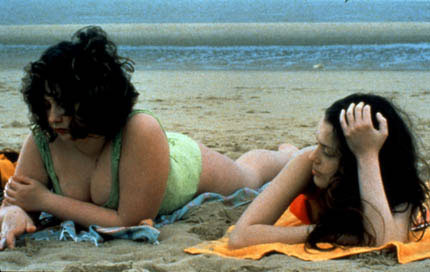 Despite being basked in a golden Mediterranean sun, Catherine Breillat’s Fat Girl is a film devoid of warmth. A cold cynicism chills the film to a frigidity oddly appropriate for a story of two sisters frolicking on a summer vacation. You see, Breillat does not view these dapper, sun-drenched family outings as fun. Like so many other films, this summer vacation represents a sexual awakening, but Fat Girl shreds through the romanticism, leaving a harsh but indelible impression.
Elena, the elder and skinner of the too, is a budding beauty who thinks or has deceived herself into thinking that she’s found love in a caddish Italian college student. Her younger sister Anais, the titular fat girl, is given the unenviable role of sleeping in the same room as Elena loses her virginity, an act the film frames as tantamount to self rape. As for her own virginity, Anais says, “I want my first time to be with a boy I don’t love.”
Anais is a frightening character indeed, a prepubescent Frankenstein in the making. The shocking finale is almost a point of personal triumph for Anais—a sickening yet resonant thought.
Fat Girl, originally titled To My Sister in French, is a look at both the complicated relationship between sisters and the not so complicated relationship between men and women. Breillat actually tones down the sex in this film, but it shocks and provokes nonetheless. Breillat’s reputation as an international provocateur takes no hit with Fat Girl; it is a cold film, but a truly incendiary one.
Surprise! Kicking Samosas Around with Howl's Psychiatrist.
Is it possible that I survived junior year with my sanity intact? End-of-the-year reminiscing sees the past year as a blur and a breeze—words that I never thought I would use to describe junior year. Alas, I have now utterly lost my motivation; simply reading a book now seems like a chore.
The school bus is a rather unfashionable hang-out for most upperclassmen, but lacking both a license and a car, I usually have no other choice. After missing the bus--my final action of junior year--I doubled back to math class to wait for Sue with Olga and Sruthi. Inevitable loitering ensued while, well, everyone else got ready.
Color me surprised when we arrived at Sruthi’s seemingly empty house, but it turned out that her friends are just too good at hiding. Following much jabbering and random outbursts, we finally got settled down to what else? A game of football! The Netherlands and Ivory Coast duked it out in Nuremberg, Germany while a group of junior girls spastically cheered them on in Acton, Massachusetts. Other than passionately rendered screams of “Gooooaaaaal!” and puns of homoerotic innuendo, the discussion somehow also included racial relations and the political ramifications of football. Wha, what? I just want to ogle at my hot guys.
More ogling ensued after the deliciously yummy lunch of Indian food, this time at males equally unavailable. Howl’s Moving Castle was a jumping, fractured narrative with way too many loose ends and strange twists, but who cares when we have Howl? Vain, self-absorbed, temperamental, and impossibly handsome both raven-haired and blonde, Howl is a sexy beast. Gratuitous “nude scene” very yummy indeed.
I suck at playing video games. No further commentary needed, though failure is very fun while it lasts.
After so much couch potatoing, we took it upon ourselves to get some fresh air. An outdoor game of psychiatrist began on a spider-like contraception made to torture toddlers and then moved to a splinterful picnic table. Very sadly, it was my time to go home afterwards.
The school bus is a rather unfashionable hang-out for most upperclassmen, but lacking both a license and a car, I usually have no other choice. After missing the bus--my final action of junior year--I doubled back to math class to wait for Sue with Olga and Sruthi. Inevitable loitering ensued while, well, everyone else got ready.
Color me surprised when we arrived at Sruthi’s seemingly empty house, but it turned out that her friends are just too good at hiding. Following much jabbering and random outbursts, we finally got settled down to what else? A game of football! The Netherlands and Ivory Coast duked it out in Nuremberg, Germany while a group of junior girls spastically cheered them on in Acton, Massachusetts. Other than passionately rendered screams of “Gooooaaaaal!” and puns of homoerotic innuendo, the discussion somehow also included racial relations and the political ramifications of football. Wha, what? I just want to ogle at my hot guys.
More ogling ensued after the deliciously yummy lunch of Indian food, this time at males equally unavailable. Howl’s Moving Castle was a jumping, fractured narrative with way too many loose ends and strange twists, but who cares when we have Howl? Vain, self-absorbed, temperamental, and impossibly handsome both raven-haired and blonde, Howl is a sexy beast. Gratuitous “nude scene” very yummy indeed.
I suck at playing video games. No further commentary needed, though failure is very fun while it lasts.
After so much couch potatoing, we took it upon ourselves to get some fresh air. An outdoor game of psychiatrist began on a spider-like contraception made to torture toddlers and then moved to a splinterful picnic table. Very sadly, it was my time to go home afterwards.
Wednesday, June 14, 2006
Sex and the Literary Mind
Vanity Fair (the magazine, not the hefty book that was turned into a frothy movie) is a worthy read, no? If not a worthy read, it is at least a worthy look with all its slick and pretty pictures. The nubile girls in seductive poses certainly nudges at a sexual innuedo that transpires directly into its articles.
Today, I cracked open the latest Vanity Fair to find a lollipop-sucking Lolita seductively glancing over her heart-shaped glasses. Given the content of the article following it, this famous image from Kubrick's Lolita posits the lollipop as something much more explicit. The article was about the history of fellatio.
Of course sex sells. This was probably only the third Vanity Fair article I've read from beginning to end. I usually find the cutesy prose peppered with oblique literary references hard to stomach, but I ate up this article nonetheless. To give credit where it is due, the article poses some interesting questions:
Why is it a blowjob? The proper technique does not involve blowing, but an action similar to what one performs when consuming a lollipop. And why is it a job? As if implying it is a service in exchange for a fee (ie prostitution.) And lastly, why do we say things "suck," when in sexual terms, it should be a high compliment? When we get to the root of things, etyomology is rather fascinating. (Bad pun.)
Today, I cracked open the latest Vanity Fair to find a lollipop-sucking Lolita seductively glancing over her heart-shaped glasses. Given the content of the article following it, this famous image from Kubrick's Lolita posits the lollipop as something much more explicit. The article was about the history of fellatio.
Of course sex sells. This was probably only the third Vanity Fair article I've read from beginning to end. I usually find the cutesy prose peppered with oblique literary references hard to stomach, but I ate up this article nonetheless. To give credit where it is due, the article poses some interesting questions:
Why is it a blowjob? The proper technique does not involve blowing, but an action similar to what one performs when consuming a lollipop. And why is it a job? As if implying it is a service in exchange for a fee (ie prostitution.) And lastly, why do we say things "suck," when in sexual terms, it should be a high compliment? When we get to the root of things, etyomology is rather fascinating. (Bad pun.)
But Vanity Fair, a magazine that has published naked girls on its cover, finds itself too classy to get into the tawdry details. The tone of the article shifts betweeen scholarly and point-and-giggle, but don't expect to find anything in the vein of "The Ultimate Question Answered: Spit or Swallow." Although I doubt anyone thinks of Philip Roth when they hear "blowjob," the article managse to reference not only that venerable American author, but also Vladmir Nabakov, Leonard Cohen, Don DeLillo's Underworld, the Kumasutra, Leonardo DaVinci, Jack the Ripper, W.H. Auden, Robert Crumb...My head was spinning with the incessant name-dropping. Amazingly, the article spends more time talking about Philip Roth than Deep Throat.
I could never quite figure out the exact readership of Vanity Fair. With its wildly diverging content (from Paris Hilton to the Dalai Lama to Prada), the magazine always seemed a publishing paradox. It sticks one foot in the world of serious journalism and another in the frivolity of celebrity, somehow balancing the two to a measure of class and status in the publishing world.
ETA: Did I really just write an entire post on Vanity Fair and oral sex? And sound incredibly pretentious while at it?Oh my god. I need to find better uses of my time.
Tuesday, June 13, 2006
Being a Senior: That's Old!
List things to do before I die? Yeah right, I can't think that far ahead. To a student, our lives are measured by academic years, not calendar ones, and sitting at the near end of junior year, I feel a need to put down some thoughts for senior year. Three-fourths of the way through my high school experience, I feel a tinge of nostalgia as the time approaches. Senior year is my last chance; I want to make the most of it.
List of things to do before graduation:
1. GET INTO COLLEGE.
2. WATCH THE ENTIRE OEUVRE OF INGMAR BERGMAN.
3. GO TO PROM.
4. FALL IN LOVE.
5. GET MY FACEBOOK INTO RESPECTABLE SHAPE.
Monday, June 12, 2006
The Hit List 6/13/06
6/12, 9:52 PM -- My head throbs like fucking hell. Technology hates me. All eloquency has flown out the window, leaving profanity in its wake.
Today, June 13, 2006, marks the last day I will ever have to step into a certain classroom. It is the last time I will ever attend the class-that-shall-not-be-named and be "taught" by she-who-shall-not-be-named. This certainly an occasion to rejoice.
A colony of ants, complete with larvae, has decided to inhabit the cold, steel interior of my mailbox. Those tiny black creepy crawlies thoroughly penetrated my mail, crawling in between the pages of Time and a hefty college viewbook. I am now officially scared to read them
Time critic Richard Schickel really likes the phrase "pretentious piffle." In his year-end wrap-ups, he's used it to describe Moulin Rouge!, Eternal Sunshine of the Spotless Mind, and I Heart Huckbees. But this guy loves Wes Anderson. Huh.
While listening to the director commentary on Amores Perros a few months ago, I jotted down a random phrase that the Innaritu had mentioned, something called "I'll Be Your Mirror." Since it was noted on one of those floating post-its, it invariably got lost in the strata of my computer desk. It was recently, through my random browsing of Limewire, that I realized it was a Velvet Underground song. Been addicted to Nico's warbling ever since.
Rejoice! My cinephiliac soul has finally seen salvation. As of today, I have access to the wonderful service of Netflix. In a mere two hours, my queue has already lengthened to 50+ and is sure to increase exponentially in the next week. Movie watching will now officially take over my life.
Wanted: Me, Myself, and I
This is another one of those lazy, summer afternoons when I have nothing to do but browse random xangas. In the midst of my reading, I envy the writing talent of some, disparage the lack thereof in others, and float off into metaphysical land. Except this isn’t a lazy summer afternoon;this is the day before English finals and I have yet to slap together an arguable thesis. Never mind that, there are much more important things to worry about.
Today I received my latest SAT scores in the mail and found that the College Board knew me as a jumble of numbers. My identity, in general, seems to be a mélange of arbitrarily chosen letters and numbers, adding up to a meaning I have yet to divine.
I don’t know who I am. I can tell you my vital stats: birthday, weight, height, weighted GPA, SAT scores, and whatnot. I can sort of tell you what I like: cinema, melancholy music, eating, easy puzzles, nifty ideas. But even that last list of “likes” I find hard to catalog. Notice the deliberate vagueness with which I describe myself; there are no definites, no clear-cut edges, no polished sheen. I feel like a blobular mass, moving lethargically along, picking up bits and pieces I encounter, only to ooze them out two feet later.
My identity is…
I can’t finish this sentence. I don’t know. Being in high school with people I have known for almost five years, I feel a burden of expectations upon me. My friends, my acquaintances, my classmates have already ascribed me a certain personality—a tough shell of expectations, from which I cannot and do not wish to escape. The shell is restraining, but comfortable.
This is why I almost fear college. In talking about Ghost World, a viewer commented how it “told the harshest truth of all: you drift away from your high school friends.” I’m only paraphrasing, as I have a special ineptitude in recalling quotes, but sitting here at the end of junior year, I find that a harsh truth indeed.
In my recommendation form for Steege, I said that I am ready for college because I am ready for independence. But independence is like being dropped in the middle of the Pacific Ocean and told to swim to shore. While I certainly do not want my parents hovering in a nearby boat, I don’t want to swim alone either. How do I know I can reach the shore of adulthood? What if it becomes an Odysseus-like journey except without the final triumph of returning home? I may be entranced by Circe. I may be trapped and eaten by a menacing Cyclops. I may forever stay on the island of Immaturity. My words on that form were obviously blatant lies through the keyboard.
Maybe I find defining identity such a difficult task because I am a normal, boring child. College will perhaps bring the bloom of a delayed adolescence. I will have my bad poetry phase. My anorexia and pink miniskirts phase. My barefoot phase. My punk rock phase. My femi-nazi phase. My mad scientist phase. My blank slate phase. My fashionlogie phase. My red balloons and glow sticks phase. My black eyeliner phase.
Moments of lucidity flee from my grasp. I must return to this final English assignment while some semblance of intelligence remains.
Today I received my latest SAT scores in the mail and found that the College Board knew me as a jumble of numbers. My identity, in general, seems to be a mélange of arbitrarily chosen letters and numbers, adding up to a meaning I have yet to divine.
I don’t know who I am. I can tell you my vital stats: birthday, weight, height, weighted GPA, SAT scores, and whatnot. I can sort of tell you what I like: cinema, melancholy music, eating, easy puzzles, nifty ideas. But even that last list of “likes” I find hard to catalog. Notice the deliberate vagueness with which I describe myself; there are no definites, no clear-cut edges, no polished sheen. I feel like a blobular mass, moving lethargically along, picking up bits and pieces I encounter, only to ooze them out two feet later.
My identity is…
I can’t finish this sentence. I don’t know. Being in high school with people I have known for almost five years, I feel a burden of expectations upon me. My friends, my acquaintances, my classmates have already ascribed me a certain personality—a tough shell of expectations, from which I cannot and do not wish to escape. The shell is restraining, but comfortable.
This is why I almost fear college. In talking about Ghost World, a viewer commented how it “told the harshest truth of all: you drift away from your high school friends.” I’m only paraphrasing, as I have a special ineptitude in recalling quotes, but sitting here at the end of junior year, I find that a harsh truth indeed.
In my recommendation form for Steege, I said that I am ready for college because I am ready for independence. But independence is like being dropped in the middle of the Pacific Ocean and told to swim to shore. While I certainly do not want my parents hovering in a nearby boat, I don’t want to swim alone either. How do I know I can reach the shore of adulthood? What if it becomes an Odysseus-like journey except without the final triumph of returning home? I may be entranced by Circe. I may be trapped and eaten by a menacing Cyclops. I may forever stay on the island of Immaturity. My words on that form were obviously blatant lies through the keyboard.
Maybe I find defining identity such a difficult task because I am a normal, boring child. College will perhaps bring the bloom of a delayed adolescence. I will have my bad poetry phase. My anorexia and pink miniskirts phase. My barefoot phase. My punk rock phase. My femi-nazi phase. My mad scientist phase. My blank slate phase. My fashionlogie phase. My red balloons and glow sticks phase. My black eyeliner phase.
Moments of lucidity flee from my grasp. I must return to this final English assignment while some semblance of intelligence remains.
Sunday, June 11, 2006
Better or Otherwise
There are certain people in the world who operate on a plane high above the conglomerate masses. Whether this plane be of intelligence, emotion, or morality, society is torn between awe and disgust at these figures standing above us.
When say society is torn, I mean that one's views on such a person depends on the individual in question. We can all admire those people who are are clearer smarter and more principled, yet do not place themselves above others. There is another breed of people entirely, who know fully well that they are better than the masses, and do nothing to hide it. These people will drag your face through the dirt and sully your conscience to exert their superiority. And indeed, these people are often master manipulators. Whether this is their intent or not, encounters with such people invariably leave you feeling like a low, low person.
Aspiring to a higher moral character is essentially a self-defeating purpose. Satisfaction derived from being moral will be entirely negated by any acts, or witnessings acts of, immorality. Wasn't English class this year a treatise on the trappings of morality? Did Anthony not deign Stevens a pathetic character for his facade of dignity? Did morality not crumble in the face of tyranny or anarchy? Did it not disappear with the first blooms of ambition? Wasn't the medieval literature a scathing satire on chivalry? Only those crusty Victorians found morality a worthy pursuit, and even then, the exercise of morality led to self-destruction and death.
I don't claim to be an especially moral person. I probably don't have the right to pass such judgment on others. But I doneed to review for my English final.
When say society is torn, I mean that one's views on such a person depends on the individual in question. We can all admire those people who are are clearer smarter and more principled, yet do not place themselves above others. There is another breed of people entirely, who know fully well that they are better than the masses, and do nothing to hide it. These people will drag your face through the dirt and sully your conscience to exert their superiority. And indeed, these people are often master manipulators. Whether this is their intent or not, encounters with such people invariably leave you feeling like a low, low person.
Aspiring to a higher moral character is essentially a self-defeating purpose. Satisfaction derived from being moral will be entirely negated by any acts, or witnessings acts of, immorality. Wasn't English class this year a treatise on the trappings of morality? Did Anthony not deign Stevens a pathetic character for his facade of dignity? Did morality not crumble in the face of tyranny or anarchy? Did it not disappear with the first blooms of ambition? Wasn't the medieval literature a scathing satire on chivalry? Only those crusty Victorians found morality a worthy pursuit, and even then, the exercise of morality led to self-destruction and death.
I don't claim to be an especially moral person. I probably don't have the right to pass such judgment on others. But I doneed to review for my English final.
It's All Downhill Now
Euphoria over finding $2 The Royal Tenenbaums Criterion DVD completely negated by impending French final.
Blood pressure at stratospheric levels.
If love can squish you flat as a pie, anger can squish you flat as a pancake.
Well-read people like to write slash.
Olga is in love.
With Ben Folds.
Not happy. Not happy. Not happy.
Too late. Too early.
[/emo pseuo-poetry]
Blood pressure at stratospheric levels.
If love can squish you flat as a pie, anger can squish you flat as a pancake.
Well-read people like to write slash.
Olga is in love.
With Ben Folds.
Not happy. Not happy. Not happy.
Too late. Too early.
[/emo pseuo-poetry]
Thursday, June 08, 2006
The Hit List 6/8/06
Due to Blogger being down this afternoon, I managed to write an entire entry in MS Word, while simultaneously procrastinating on my recommendation letters and final review.
Who knew the combination of Diet Coke and mint Mentos was so potent? I love these guys in their super serious lab coats and goggles. With their popularity exploding in the last week, it seems we must be prepared for a shortage of Diet Coke and Mentos in the coming months.
When I got the mail yesterday, I found Sarah Jessica Parker grinning back at me on the slick blue cover of Good Housekeeping magazine. Convinced that this magazine was wrongly stuffed into my mailbox, I found the subscription label to bear the name of noneother than my good ol' dad. I must get to the bottom of this mystery.
Shudder. Why is Frankenstein continuing to plague the ongoings of my life? Guster's "One Man Wrecking Machine" is a lovely and intensely cute tribute to the book. And very rare indeed considering our 12 year age difference, my brother and I both love it. Too bad the music video is better than the actual book.
French class today was a sort-of party unholily married to a National French Exam award ceremony. Ate lots of sugar. Was pleasantly surprised.
Bye bye Miss American Pie...stupidly addictive song.
Who knew the combination of Diet Coke and mint Mentos was so potent? I love these guys in their super serious lab coats and goggles. With their popularity exploding in the last week, it seems we must be prepared for a shortage of Diet Coke and Mentos in the coming months.
When I got the mail yesterday, I found Sarah Jessica Parker grinning back at me on the slick blue cover of Good Housekeeping magazine. Convinced that this magazine was wrongly stuffed into my mailbox, I found the subscription label to bear the name of noneother than my good ol' dad. I must get to the bottom of this mystery.
Shudder. Why is Frankenstein continuing to plague the ongoings of my life? Guster's "One Man Wrecking Machine" is a lovely and intensely cute tribute to the book. And very rare indeed considering our 12 year age difference, my brother and I both love it. Too bad the music video is better than the actual book.
French class today was a sort-of party unholily married to a National French Exam award ceremony. Ate lots of sugar. Was pleasantly surprised.
Bye bye Miss American Pie...stupidly addictive song.
Spectrum Wars
6/5/06 The Spectrum
6/6/06 A Broader Spectrum
6/7/06 The Narrow Spectrum
In the last week, a number of official and unofficial school publications have managed to cover what was once thought impossible—the entire spectrum on news available at AB. Granted, there isn’t much news at AB, but impressively, these three publications managed to publish on consecutive days.
I understand there are both petty and humane reasons for the existence of A Broader Spectrum, some of which may have to do indirectly with me. I greatly admire and respect the tenacity of the founders who got their issue together, despite the broad opposition that they faced from the administration. Yet, I cannot respect BS (too easy, too easy) as a publication. They call themselves an underground paper, all the while subverting the very point of an underground paper
The Broader Spectrum wants to be an eye-opener (as represented in the front page graphic), “bringing personality back to the news.” What it actually does, however, is lob political softballs on issues already overplayed in the media. It functions as a liberal speaker preaching in a liberal echo chamber to a very liberal choir. These type of cotton-candy “news” does nothing to shake AB out of its current complacency, which was seen the demise of VOICE, MESA, Common Ground, and pretty much every other socially aware group.
If it wants to succeed, the Broader Spectrum needs to be more than an “underground” hybrid of Spectrum/Lit Mag/Idiosyncrasy/CNN World News printed on hand-stapled, black-and-white, low-quality paper.
On the subject of The Narrow Spectrum, there are no words. All bow down.
6/6/06 A Broader Spectrum
6/7/06 The Narrow Spectrum
In the last week, a number of official and unofficial school publications have managed to cover what was once thought impossible—the entire spectrum on news available at AB. Granted, there isn’t much news at AB, but impressively, these three publications managed to publish on consecutive days.
I understand there are both petty and humane reasons for the existence of A Broader Spectrum, some of which may have to do indirectly with me. I greatly admire and respect the tenacity of the founders who got their issue together, despite the broad opposition that they faced from the administration. Yet, I cannot respect BS (too easy, too easy) as a publication. They call themselves an underground paper, all the while subverting the very point of an underground paper
The Broader Spectrum wants to be an eye-opener (as represented in the front page graphic), “bringing personality back to the news.” What it actually does, however, is lob political softballs on issues already overplayed in the media. It functions as a liberal speaker preaching in a liberal echo chamber to a very liberal choir. These type of cotton-candy “news” does nothing to shake AB out of its current complacency, which was seen the demise of VOICE, MESA, Common Ground, and pretty much every other socially aware group.
If it wants to succeed, the Broader Spectrum needs to be more than an “underground” hybrid of Spectrum/Lit Mag/Idiosyncrasy/CNN World News printed on hand-stapled, black-and-white, low-quality paper.
On the subject of The Narrow Spectrum, there are no words. All bow down.
Tuesday, June 06, 2006
The Hit List 6/6/06
The Antichrist is coming! Or not, since everything seems appalling normal right now. I did, however, encounter one somewhat odd occurrence when the lamp on my desk fell directly onto a plate of grapes, shattering a small chunk of the plate. Prophetic? Metaphorical? Ominous? Who cares?
If then is to be some apocalypse today, I would first like to take a moment to rue the end of one wonderful class—AP Bio. In a class where silliness and nerdiness mingled abashedly with intellect and science, I had some of the highest highs and lowest lows of my junior academic career. As we reluctantly left the class during its final moments, the last few minutes of Contact played out in the darkened classroom. And what a finale. I loved Contact. I loved the delicious layers of irony. I loved the corny clichés of its genre. I loved Jodie Foster. I loved the tracking shot to the mirror. I loved everything except a smarmy Matthew McConaughey, who ribbed me to no end.
I finished reading Perfume: The Story of a Murderer (aka book with boob on cover), an awkwardly translated but entertaining novel. Perfume takes on the diffcult task of transcribing smell--a sense all too epheremal and unfamiliar in the language of words.The novel does a more than adequate job in that regard, but its main character, the thoroughly evil Jean-Baptist Grenouille, failed to interest me in the least. The ending, however, was so gruesome and flamboyant as to blast itself into my mind. Interesting read, and despite its dark tone, a rather fluffly one. On a side note, I can totally see Tom Twyker adapting this book into a movie; the flashforwards are all too reminiscent of his directorial style.
To further prove the frightening amount of information colleges have managed to accrue me, I got a call from an economics major at Carnegie Mellon. After bumbling about awkwardly for a few seconds, I realized he was trying to get me to ask questions about CMU. Not wanting to turn him down flat, I proceeded to quiz him on the economics program at CMU, when he half-admitted was transferring elsewhere and found his job prospects rather poor. The kid was pretty nervous. I hope he is getting paid to deal with stupid people like me.
Like a bird on a wire
Like a drunken midnight choir
I have tried, in my way, to be free...
Why am I so attracted to slow, sad music? Leonard Cohen has such a beautiful, deep, soothing, and melancholy voice.
If then is to be some apocalypse today, I would first like to take a moment to rue the end of one wonderful class—AP Bio. In a class where silliness and nerdiness mingled abashedly with intellect and science, I had some of the highest highs and lowest lows of my junior academic career. As we reluctantly left the class during its final moments, the last few minutes of Contact played out in the darkened classroom. And what a finale. I loved Contact. I loved the delicious layers of irony. I loved the corny clichés of its genre. I loved Jodie Foster. I loved the tracking shot to the mirror. I loved everything except a smarmy Matthew McConaughey, who ribbed me to no end.
I finished reading Perfume: The Story of a Murderer (aka book with boob on cover), an awkwardly translated but entertaining novel. Perfume takes on the diffcult task of transcribing smell--a sense all too epheremal and unfamiliar in the language of words.The novel does a more than adequate job in that regard, but its main character, the thoroughly evil Jean-Baptist Grenouille, failed to interest me in the least. The ending, however, was so gruesome and flamboyant as to blast itself into my mind. Interesting read, and despite its dark tone, a rather fluffly one. On a side note, I can totally see Tom Twyker adapting this book into a movie; the flashforwards are all too reminiscent of his directorial style.
To further prove the frightening amount of information colleges have managed to accrue me, I got a call from an economics major at Carnegie Mellon. After bumbling about awkwardly for a few seconds, I realized he was trying to get me to ask questions about CMU. Not wanting to turn him down flat, I proceeded to quiz him on the economics program at CMU, when he half-admitted was transferring elsewhere and found his job prospects rather poor. The kid was pretty nervous. I hope he is getting paid to deal with stupid people like me.
Like a bird on a wire
Like a drunken midnight choir
I have tried, in my way, to be free...
Why am I so attracted to slow, sad music? Leonard Cohen has such a beautiful, deep, soothing, and melancholy voice.
Monday, June 05, 2006
The Age Old Debate (Not Really)
I've always been perplexed by those who adamantly pit science and humanities against each other as if there were mortal enemies. Propogated at AB by the likes of Noeth and Anthony, and their respective disciples, this debate rages in high school as if there was a true conflict.
In the midst of a Frankenstein discussion, Anthony, a self-admitted humanities advocate, once again dragged up the topic of science v. humanities. "Be careful, you science people," she warned. "You must take responsibility."
Interesting that Anthony should frame the debate this way, as if science were a rampant monster strewning destruction through society. Of course there are morally ambiguous areas of science, but there is no need for debate on whether science has changed society for the better or the worse. Science is far, far from a destructing force; it is the foundation on which our society lies. If Anthony would prefer a world where everyone sits around in Socratic seminars discussing the inherent nature of man, that is fine. But this Socratic seminar would take place in a lightless stone cave.
Ironically, in urging responsibility of scientists, Anthony also demeans the work of her treasured humanties. Are humanities so trivial to society that its creators have no need to take responsibility? Does the work of a poet, musician, philosopher, writer, filmmaker or theologian have no bearing on society? Absolutely not. These creators, as any scientist, must shoulder their responsibiltiy as well.
On a wanton whim, the atomic bomb can kill millions. But how many people has religion killed? The Crusades. The genocides. The suicide bombs. Conflicts continue to rage. Religion, originally a march toward peace and harmony, has provoked and caused the death of untold millions in the course of history. And these deaths were made possible with increasing deadly technology.
There is no inherent divide. Ideas and techonolocy work in tandem toward destruction or creation. It is our choice. We must all take responsibility.
In the midst of a Frankenstein discussion, Anthony, a self-admitted humanities advocate, once again dragged up the topic of science v. humanities. "Be careful, you science people," she warned. "You must take responsibility."
Interesting that Anthony should frame the debate this way, as if science were a rampant monster strewning destruction through society. Of course there are morally ambiguous areas of science, but there is no need for debate on whether science has changed society for the better or the worse. Science is far, far from a destructing force; it is the foundation on which our society lies. If Anthony would prefer a world where everyone sits around in Socratic seminars discussing the inherent nature of man, that is fine. But this Socratic seminar would take place in a lightless stone cave.
Ironically, in urging responsibility of scientists, Anthony also demeans the work of her treasured humanties. Are humanities so trivial to society that its creators have no need to take responsibility? Does the work of a poet, musician, philosopher, writer, filmmaker or theologian have no bearing on society? Absolutely not. These creators, as any scientist, must shoulder their responsibiltiy as well.
On a wanton whim, the atomic bomb can kill millions. But how many people has religion killed? The Crusades. The genocides. The suicide bombs. Conflicts continue to rage. Religion, originally a march toward peace and harmony, has provoked and caused the death of untold millions in the course of history. And these deaths were made possible with increasing deadly technology.
There is no inherent divide. Ideas and techonolocy work in tandem toward destruction or creation. It is our choice. We must all take responsibility.
Saturday, June 03, 2006
The Hit List 6/3/06
Today marked the last SAT II subject tests that I will ever take. I say this with a measure of hopefulness and cheerful optimism because it is certainly the last chance I have to take any SAT IIs. Despite breezing through the Math IIC ("The easiest test evaaaah!" according to my classmates), I have a horrible sinking feeling that I somehow totally fucked up my bubbling. Sigh, must get rid of excessive paranoia.
How did I not discover the magic of Windows Movie Maker before? After spending 4 hours at Liz's house editing our history project video, I have finally been initiated in the awesome wonderfulness that is Windows Movie Maker. The history project, by the way, is also wonderfully awesome. And Liz's dog is cute and fat and smelly, but most of all cute.
It is once again raining and pouring and the old man is snoring--the old man representing my inner child who craves sunshine and dandelions. Uh, that metaphor is very disturbing in way; I am in no way implying that children should have any type of Jekyll/Hyde relationships with old men. Nor should there be any three-ways between children, old men and teenage girls. Topic: Why is it still raining? Acton have invoked the wrath of God to deserve such an utter downpour dousing our spirits and our lawns.
In a place where it is bright and sunny, a group of elite athletes are slugging it out on the streaky red clay of Roland Garros. I'm not really a tennis afianciado but watching tennis is an enjoyable and appropriately brainless way to spend a Saturday morning. Besides, what's hotter than a sweaty guy streaked in red dust? I tried watching the highlights of the Nadal-Mathieu match online but the ball completely disappears into thin air when your viewing screen is only 3 inches. All I'm getting is two guys grunting back and forth--not hot. I really detest this whole thing with grunting; it's the most unpleasant, jarring, and borderline gross behavior. If you're going to play well, play with class. Who else but Federer?
How did I not discover the magic of Windows Movie Maker before? After spending 4 hours at Liz's house editing our history project video, I have finally been initiated in the awesome wonderfulness that is Windows Movie Maker. The history project, by the way, is also wonderfully awesome. And Liz's dog is cute and fat and smelly, but most of all cute.
It is once again raining and pouring and the old man is snoring--the old man representing my inner child who craves sunshine and dandelions. Uh, that metaphor is very disturbing in way; I am in no way implying that children should have any type of Jekyll/Hyde relationships with old men. Nor should there be any three-ways between children, old men and teenage girls. Topic: Why is it still raining? Acton have invoked the wrath of God to deserve such an utter downpour dousing our spirits and our lawns.
In a place where it is bright and sunny, a group of elite athletes are slugging it out on the streaky red clay of Roland Garros. I'm not really a tennis afianciado but watching tennis is an enjoyable and appropriately brainless way to spend a Saturday morning. Besides, what's hotter than a sweaty guy streaked in red dust? I tried watching the highlights of the Nadal-Mathieu match online but the ball completely disappears into thin air when your viewing screen is only 3 inches. All I'm getting is two guys grunting back and forth--not hot. I really detest this whole thing with grunting; it's the most unpleasant, jarring, and borderline gross behavior. If you're going to play well, play with class. Who else but Federer?
Friday, June 02, 2006
Kingdom of Heaven (Scott, 2005)
 A good epic is the very epitome of a cinematic experience. Amidst the exotic sets and moments of rousing glory, you taken for three hours to a world wholly different from the real—in a world where villains crackle, beauties tempt, swords flash, and heroes always win.
 I begin with this paragraph because Kingdom of Heaven is not a traditional epic. Untraditional in the sense that the “hero” is not a hero, the “villain” is not a villain and the “victory” is not a victory. This is admirable endeavor on the part of director Ridley Scott, even if it keeps his film from attaining the highest peak. (This review refers to the Director’s Cut released on DVD.)
Kingdom of Heaven tells the story of Balian (Orlando Bloom), a French blacksmith who is reluctantly thrown into his role as hero. After killing the lord’s nephew, Balian is forced to go to Jerusalem with a company of Crusaders who pass his village. The film moves as a brisk pace until we get to Jerusalem, where we are introduced to the king (a masked Ed Norton), his sister Sibylla (Eva Green), and her devious husband Guy de Lusignan (Marton Czokas). As Sibylla is literally the only female character in the film, our hero aptly begins a laborious love affair with her.
Sibylla’s brother, the judicial King Baldwin, rules Jerusalem with an even hand. It has been 100 years since the Christians reclaimed Jerusalem, and there are once again seeds of a Muslim uprising led by Saladin. In retelling a battle between Christians and Muslims, Kingdom of Heaven has a political undertone that is hard to ignore. Yet Scott admirably maintains a fair and balanced approach, refusing to paint either side in broad black and white strokes. In this Kingdom of Heaven, Christians and Muslims live together largely in peace, and Saladin even sends his physicians to tend the Christian king. But recent bloodshed has stirred the pot, and all it takes is a hot-blooded firebrand to make it boil over.
Our hero, Balian, is not this firebrand. When the peace is suddenly shattered, a reluctant Balian finds himself literally and figuratively in the crossfire. Here, our hero finally steps up, and here, the film itself falls flat. Despite some thrilling battle sequences, Kingdom of Heaven never quite achieves the triumphant climax that marks an epic.
The blame lies in both the script and in Bloom’s performance. Bloom may be simply playing the character as written—inert and merely reacting—but even his rousing sequences fail to inspire. To put it plainly, Bloom's Balian is milquetoast. You've got to hand to the guy though; throughout the film, he endures all kinds of torture as he's bloodied, dirtied, and burnt. But bloodied, dirtied, and burnt milquetoast is still milquetoast.
What redeems Kingdom are its lavish technical production and the exceptional cast of secondary characters that far outshine Bloom. Perhaps it is the presence of such lush sets and characters that make Balian seem bland in comparison. Especially memorable is Green’s Sibylla, whose transformation in the film is utterly believable and real.
Epics require a certain suspension of disbelief. If the ingredients are blended just right, the effect is a rousing tale of love and courage. Done incorrectly, it simply becomes a hokey story with excessive sex and gore. Scott eschews the time-tested elements of an epic, and while it is daring, it is these choices that tamper Kingdom of Heaven down from the great to the merely good. Kingdom of Heaven never quite rises to its heights, merely panning out to an end. It is still, however, a sumptuous, complex piece of filmmaking.
Subscribe to:
Posts (Atom)